

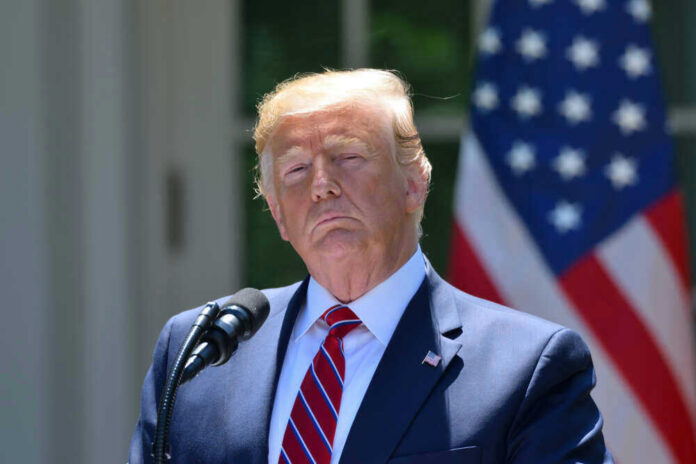
President Trump’s economic approval rating just hit 30%, a stunning eight-point plunge in a single month that threatens to unravel his signature political strength heading into crucial midterm elections.
Story Snapshot
- Trump’s economic approval collapsed from 38% to 30% between March and April 2026, with cost-of-living approval at just 23%
- Even Republican support eroded sharply, dropping from 74% to 62% on economic handling, as strong approval fell from 51% to 38%
- Rising gas prices from the Iran conflict and stalled tariff policies triggered the decline, with 73% of Americans now viewing the economy as poo.r
- The AP-NORC poll of 2,596 adults signals midterm vulnerability for Republicans defending congressional seats on Trump’s economic record.rd
The Foundation Cracks on Trump’s Core Asset
Trump returned to office in January 2025, promising a golden age built on tax cuts and tariffs, inheriting roughly 3% inflation with 42% overall approval and 40% on the economy.
Fifteen months later, that foundation shows deep fissures. The AP-NORC poll conducted April 16-20, 2026, reveals that only three in ten Americans approve of his economic stewardship.
The Consumer Price Index climbed to 3.3% year-over-year in March 2026, surpassing inherited levels, while hiring stalled amid tariff uncertainty. Promises of lower prices collided with reality at gas pumps and grocery checkout lines.
Trump's approval on economy falls in AP-NORC poll, showing new warning signs for president https://t.co/efTJmVhEZ2
— The Washington Times (@WashTimes) April 22, 2026
The Iran war proved the accelerant. U.S. attacks in February 2026 triggered Iranian closures of the Strait of Hormuz, choking global oil flows and spiking fuel costs precisely when Trump had pledged relief.
The waterway’s volatile open-close cycle through April compounded consumer frustration. By the time pollsters reached households, 76% disapproved of Trump’s handling of the cost of living.
This represents more than partisan griping. The 23% approval rating for living costs signals widespread economic pain that cuts across usual political divides, touching wallets in ways campaign rhetoric cannot deflect.
Republican Enthusiasm Evaporates at Alarming Speed
The most ominous warning for Trump lurks within his own coalition. Republican approval of economic handling dropped twelve points in one month, from 74% to 62%.
Strong approval among Republicans on cost-of-living management barely crossed the majority threshold at 51%, down from healthier levels just weeks prior.
Political analyst Chris Cillizza noted the bare majority among the base signals potential disaster, questioning whether Trump is losing the issue that won him elections. Independents, hovering around 20% approval, offer no safety net. When your base wobbles and persuadables flee, midterm defenses crumble rapidly.
This erosion differs from typical polling fluctuations. March 2026 showed Trump at 38% overall and economic approval, with Republican strong approval at 51%.
The April poll registers declines across every measured dimension simultaneously. Overall approval fell to 33%, while 72% say the country heads are in the wrong direction.
The consistency of negative movement across demographics suggests not statistical noise but genuine sentiment shifts driven by tangible economic deterioration. Republicans defending House and Senate seats cannot distance themselves from a president whose policies created the conditions voters reject daily at the pump.
Historical Parallels Offer Cold Comfort
Trump’s trajectory mirrors President Biden’s plunge to 36% approval in July 2022 amid inflation peaks, which later partially recovered. The crucial difference lies in causation.
Biden faced domestic inflation pressures primarily; Trump confronted geopolitical volatility he initiated through the Iran conflict, layered atop tariff-induced economic stagnation.
The December 2025 poll already showed economic approval at near 30%, with 70% viewing conditions as poor, suggesting the April decline represents the acceleration of existing trends rather than a sudden shock.
Recovery requires either conflict resolution, lower gas prices, or significant easing of inflation; none of which is guaranteed, given policy inconsistency on energy and trade.
The poll’s methodology ensures credibility. AP-NORC’s AmeriSpeak Panel surveyed 2,596 adults with a margin of error of plus or minus 2.6% points, using probability-based sampling for national representativeness.
The consistency across multiple polls from December 2025 through April 2026 validates the downward trend. Trump entered his second term with economic approval at 40% in March 2025; thirteen months later, it stands at 30%, a full ten-point decline concentrated heavily in recent months as the consequences of the Iran war materialized. The data reflects policy failures on core promises, not media narratives or partisan spin.
Trump’s approval on economy falls in AP-NORC poll, showing new warning signs for president https://t.co/D4R547JT8k
— Chicago Breaking News (@ChicagoBreaking) April 21, 2026
Americans face concrete consequences beyond polling abstractions. Gas prices remain elevated, groceries cost more, and tariffs created hiring limbo despite tax cut promises.
The energy sector staggers amid Middle East disruption as Trump’s policies intensify. For Republicans eyeing November midterms, defending Trump’s economic brand grows harder when 73% of voters see conditions as poor.
The question becomes whether Trump can reverse course on Iran, moderate tariff chaos, and deliver tangible relief before voters render their own approval ratings at the ballot box.
Sources:
Fewer approve of Trump’s handling of the economy – AP-NORC
Trump’s approval on economy falls in AP-NORC poll, showing new warning signs for president – AP News
Trump’s approval rating slips on the economy and immigration – AP-NORC