
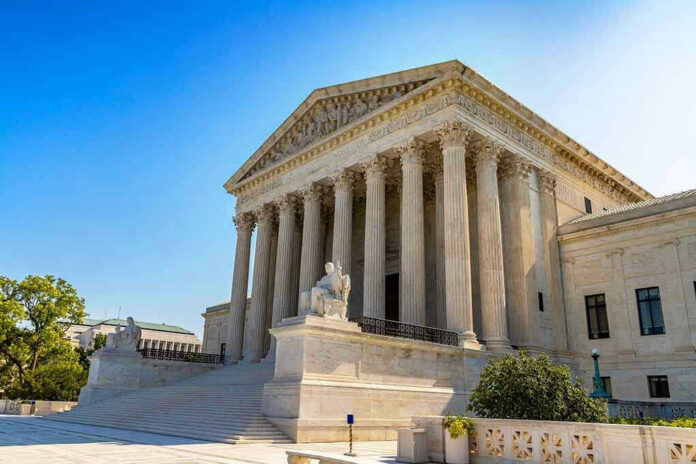
The Supreme Court just handed Louisiana a green light to redraw its congressional map mid-election while two justices publicly brawled over whether the Court itself has abandoned neutrality.
Story Snapshot
- Supreme Court bypassed standard 32-day waiting period to implement landmark Louisiana redistricting ruling immediately ahead of 2026 midterms
- Justice Alito called Justice Jackson’s institutional concerns “baseless and insulting,” while she accused the Court of abandoning impartiality
- Louisiana suspended May primaries and began redrawing congressional maps that could eliminate majority-Black districts
- New legal standard requires “strong inference” of intentional racial discrimination, effectively gutting Section 2 of the Voting Rights Act
- Tennessee and Alabama launched similar mid-election redistricting efforts following the Court’s decision
When Justices Stop Being Polite and Start Getting Real
The Supreme Court doesn’t typically turn into a verbal cage match, but May 4, 2026, proved exceptional. Justice Samuel Alito torched Justice Ketanji Brown Jackson’s dissent as “groundless and utterly irresponsible” after she suggested the Court abandoned its principles by fast-tracking Louisiana’s redistricting case.
Jackson fired back that the Court should have stayed neutral rather than “influence its implementation.” The public spat exposed something rarely visible: justices questioning each other’s integrity over whether the Court itself appears partisan.
Alito argued that delaying would force Louisiana to use an unconstitutional map, while Jackson countered that the rush job created an appearance of taking sides in an election-year redistricting battle.
Supreme Court lets Louisiana redistricting ruling take effect immediately, sparking angry words between Alito and Jackson https://t.co/AByfc8QCFe
— CBS News (@CBSNews) May 5, 2026
The Procedural Fast Track That Triggered the Fight
Supreme Court Rule 45.3 normally gives states 32 days before rulings take effect, a cooling-off period that allows for orderly implementation. The Court shredded that timeline, granting Louisiana’s request to implement its April 29 decision immediately.
Voters who originally challenged Louisiana’s map requested the expedited order, arguing that “time is of the essence” as the 2026 elections approach.
The Court agreed, allowing Louisiana to start redrawing maps instantly rather than waiting until early June. Jackson saw this as the Court inserting itself into messy political territory.
Alito saw it as preventing Louisiana from being forced to use a map the Court just declared unconstitutional. Both positions have merit, which explains why the dispute became so heated.
What Louisiana v. Callais Actually Changed
The underlying April 29 ruling established a new standard, making it vastly harder to prove voting rights violations under Section 2 of the Voting Rights Act. Previously, plaintiffs could demonstrate that district maps diluted minority voting power through statistical analysis and electoral patterns.
Now they must prove “strong inference that the State intentionally drew its districts to afford minority voters less opportunity because of their race.”
Justice Elena Kagan’s dissent characterized this as rendering Section 2 “all but dead-letter” since proving intentional discrimination is extraordinarily difficult.
Alito’s majority opinion justified the stricter standard by citing “important developments,” including higher Black voter turnout and the elimination of explicitly discriminatory voting laws. The decision fundamentally reshapes redistricting law across America.
The Redistricting Domino Effect
Louisiana suspended its May 2026 House primaries immediately after the Court’s expedited order, with the Republican-controlled legislature preparing to redraw congressional maps that could eliminate majority-Black districts.
Tennessee and Alabama launched similar redistricting efforts, recognizing an opportunity to reshape their congressional delegations before the midterms.
The NAACP Legal Defense Fund and other voting rights organizations filed challenges, but the compressed timeline leaves little room for lengthy litigation.
Governor Jeff Landry authorized the emergency redistricting process, arguing that Louisiana must comply with the Supreme Court’s constitutional mandate.
Critics see coordinated Republican efforts to reduce Democrat representation while the legal window remains open. The practical effect: congressional maps initially drawn after the 2020 census may be redrawn mid-decade, mid-election cycle.
The Voting Rights Act Unravels Further
Section 2 of the Voting Rights Act has been under assault for years, and Louisiana v. Callais delivers perhaps the fatal blow. After Shelby County v. Holder gutted preclearance requirements in 2013, Section 2 remained the primary tool for challenging discriminatory redistricting. The new “strong inference” standard raises the evidentiary bar so high that proving violations becomes nearly impossible.
States no longer need to create majority-minority districts when feasible unless plaintiffs can demonstrate intentional racial discrimination rather than mere discriminatory effect.
This shifts decades of redistricting jurisprudence toward states’ rights and away from federal oversight. Conservative legal scholars argue this reflects proper constitutional interpretation, ending race-conscious redistricting that itself violated equal protection principles. Voting rights advocates see the destruction of the Voting Rights Act’s core enforcement mechanism.
The Institutional Legitimacy Question
Jackson’s core concern extends beyond this specific case to the Supreme Court’s institutional reputation. She argued the Court should “stay on the sidelines” rather than appear to greenlight Louisiana’s suspension of primaries and emergency redistricting. The expedited implementation, she suggested, makes the Court look like a political actor rather than a neutral arbiter.
Alito rejected this framing entirely, arguing that refusing to act would itself appear partisan by forcing Louisiana to use an unconstitutional map.
The public dispute reveals justices wrestling with how the Court should navigate politically charged cases during election cycles. Public confidence in judicial impartiality matters for institutional legitimacy, yet both action and inaction can appear partisan depending on perspective. The exchange exposed this impossible bind with unusual candor.
What Comes Next for Affected Voters
Black voters in Louisiana face potential dilution of their voting power through the elimination of majority-Black congressional districts that previously gave them meaningful electoral influence. The redrawn maps could reduce Democrat representation not just in Louisiana but across multiple states following the precedent.
District courts must now quickly determine implementation procedures while ongoing litigation challenges the primary suspensions and redistricting processes.
The compressed timeline leaves voters uncertain about when elections will be held, which districts they’ll vote in, and whether their representation will be preserved.
Multiple state and federal court cases remain pending, but the Supreme Court’s expedited order suggests lower courts have limited authority to block implementation. The 2026 midterms will proceed under whatever maps state legislatures produce in the coming weeks.
Sources:
Politico: Supreme Court lets Louisiana redistricting ruling take effect immediately
Democracy Docket: Supreme Court clears path for Louisiana to gerrymander mid-election
Votebeat: Florida redistricting Supreme Court Louisiana Callais gerrymander 2026 election
CBS News: Supreme Court Louisiana redistricting ruling take effect immediately Alito Jackson
NAACP Legal Defense Fund: Louisiana v. Callais