
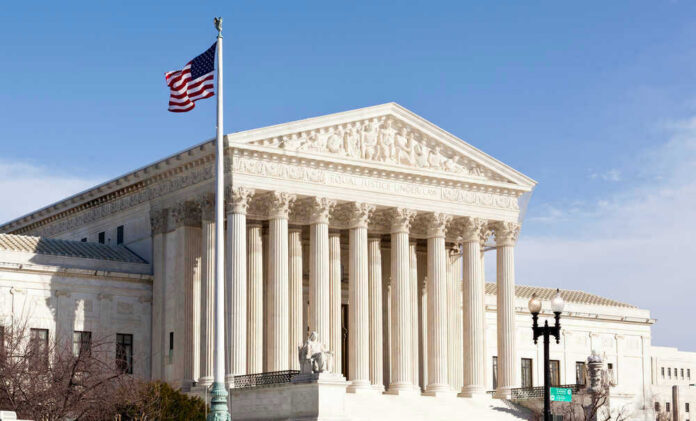
The Supreme Court just delivered a 9-0 rebuke to corporate legal maneuvering that attempted to shield a major baby food manufacturer from accountability in a Texas courtroom over allegations that toxic heavy metals harmed a child.
Story Highlights
- Supreme Court unanimously rules federal court lacked jurisdiction in baby food heavy metals case, sending it back to Texas state court
- Parents allege Hain Celestial’s baby food caused their child’s developmental disorders from toxic metals exposed in 2021 congressional report
- Manufacturer tried dodging Texas jury by removing case to federal court through questionable dismissal of Whole Foods co-defendant
- Ruling closes corporate loophole that allowed out-of-state companies to manipulate venue and escape local accountability
Corporate Attempt to Escape Texas Justice Fails
Hain Celestial Group, a Delaware-based baby food manufacturer, attempted to escape a Texas jury by removing Sarah and Grant Palmquist’s lawsuit from state to federal court. The couple sued both Hain and Texas-headquartered Whole Foods after their child allegedly suffered developmental disorders from heavy metals in Hain’s “Earth’s Best” baby food products.
The manufacturer argued for diversity jurisdiction, but faced a problem: both plaintiffs and Whole Foods were Texas residents, defeating the complete diversity required for federal court. A district court conveniently dismissed Whole Foods as “improperly joined,” proceeded to trial, and ruled for Hain.
Unanimous Supreme Court Restores Accountability
Justice Sotomayor’s February 24, 2026 opinion for all nine justices slammed this jurisdictional sleight of hand. The Court affirmed the Fifth Circuit’s reversal, holding that the erroneous dismissal of Whole Foods “did not cure” the fundamental lack of diversity jurisdiction that “lingered through judgment.”
This means federal courts cannot retroactively create authority they never possessed by wrongly kicking out in-state defendants. The ruling vacates the entire federal judgment favoring Hain and returns the case to Texas state court, where both defendants must now face the music before a local jury—exactly what corporate lawyers tried to avoid.
Supreme Court unanimously rebukes lower court's handling of Whole Foods baby food case https://t.co/kHw1KwJuRK
— FOX Business (@FoxBusiness) February 24, 2026
Congressional Report Exposed Baby Food Industry’s Toxic Secret
The Palmquists’ lawsuit stems from a damning 2021 U.S. House Oversight Subcommittee report titled “Pathways to Poison,” which documented dangerous levels of arsenic, lead, cadmium, and mercury in baby foods from Hain Celestial and other manufacturers.
The parents claim they unknowingly fed these contaminated products to their child, who at age two-and-a-half showed developmental disorders that doctors linked to heavy metal exposure.
Their Texas lawsuit alleges product liability, negligence, breach of warranty, and misrepresentation—charging that both the manufacturer and retailer failed to warn families about risks that congressional investigators found serious enough to publicize nationally.
Ruling Protects State Courts From Federal Forum Shopping
This decision slams the door on a favored corporate tactic: manufacturing federal diversity jurisdiction by dismissing local co-defendants. Under 28 U.S.C. § 1332(a), federal diversity jurisdiction requires parties from different states and over $75,000 in controversy. Out-of-state defendants like Hain often prefer federal courts over state venues, where local juries may sympathize with hometown plaintiffs.
The Supreme Court’s unanimous stance makes clear that procedural gamesmanship cannot override constitutional limits on federal power. Legal analysts at Dorsey & Whitney noted the ruling clarifies that courts must possess proper jurisdiction from the outset—errors cannot create authority that never existed.
This protects the Tenth Amendment principle that state courts retain primacy over local disputes unless federal jurisdiction is genuinely established.
Implications for Baby Food Safety Litigation Nationwide
The Palmquist case is part of broader multidistrict litigation involving baby food toxins allegedly linked to autism and ADHD in children. The Supreme Court’s decision strengthens the hand of families pursuing accountability in state courts, where punitive damages and jury trials may yield more favorable outcomes than federal forums.
Food manufacturers and retailers now face heightened liability exposure, as they cannot easily escape to federal court by dismissing local co-defendants. This ruling may consolidate more claims in plaintiff-friendly state venues, potentially accelerating pressure on the baby food industry to address safety concerns exposed by the 2021 congressional investigation that started this wave of litigation.
The case now returns to Texas state court for trial on the merits against both Hain Celestial and Whole Foods, with no further procedural escape hatches available. Families deserve transparency about what goes into products they trust for their children’s health, and this ruling ensures corporations cannot hide behind jurisdictional technicalities when serious questions about toxic contamination demand answers.
Sources:
Supreme Court unanimously rebukes lower court’s handling of Whole Foods baby food case – KTVU
Supreme Court Update – Dorsey & Whitney
Baby Food Autism Lawsuit – Lawsuit Information Center
Justices send litigation about tainted baby food back to state court – SCOTUSblog
Hain Celestial Group v. Palmquist – Supreme Court Opinion
U.S. Supreme Court allows case involving alleged toxic baby food to advance – VitalLaw
High Court puts Whole Foods back in hot seat over baby food debacle – Courthouse News