

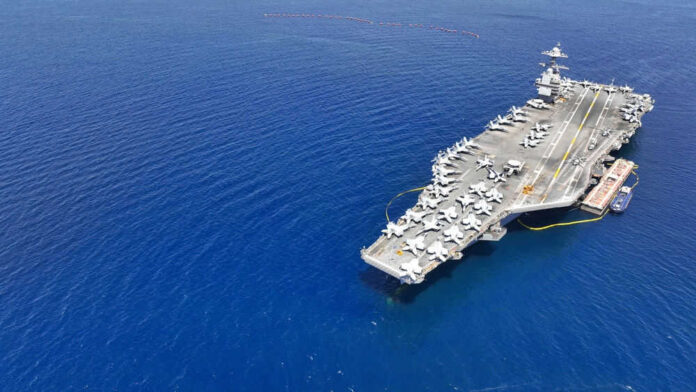
President Trump has deployed a massive naval armada to the Middle East in a show of American strength that signals Iran’s dangerous nuclear ambitions will no longer be tolerated under this administration.
Story Snapshot
- USS Abraham Lincoln carrier strike group arrived in Middle East waters near Iran, marking Trump’s strongest military response to the regime’s nuclear threats
- Deployment includes F-35C stealth fighters, Tomahawk cruise missile-armed destroyers, B-52 bombers, and advanced air defense systems protecting American forces and allies
- Strike group deployment follows June 2025 U.S. military strikes against Iranian nuclear facilities and comes amid Iran’s brutal crackdown that reportedly killed 20,000 protesters
- Trump emphasized a preference for avoiding military conflict while maintaining overwhelming deterrence: “We have an armada heading in that direction, and maybe we won’t have to use it.”
Trump Deploys Overwhelming Military Force
The USS Abraham Lincoln carrier strike group arrived in the Middle East in late January 2026, positioning America’s most advanced naval power within operational range of Iran.
The deployment includes Carrier Air Wing 9 with F-35C Lightning II stealth fighters and F/A-18E/F Super Hornets, backed by Arleigh Burke-class destroyers carrying Tomahawk cruise missiles.
President Trump publicly announced the deployment on January 23, stating, “We have a big force going toward Iran. I’d rather not see anything happen, but we will see.” This represents the kind of peace-through-strength approach that conservatives have long advocated.
The U.S. Navy’s Lincoln carrier strike group has arrived in the Middle East, per Israel’s Channel 13.
The group brings significant strike and air defense capabilities to the region. pic.twitter.com/XIHgajZolX
— OSINTtechnical (@Osinttechnical) January 25, 2026
Comprehensive Military Buildup Protects American Interests
The carrier strike group is just one component of a broader military buildup that demonstrates America’s commitment to regional stability and allied security. F-15E Strike Eagles have deployed to Jordan, while B-52 Stratofortress bombers operate from Qatar, creating multiple layers of offensive capability.
Additional Patriot and THAAD air defense systems are being positioned throughout the region to protect U.S. bases and personnel from potential Iranian retaliation.
A dedicated missile defense vessel is en route to Israel, reinforcing America’s commitment to defending our closest Middle Eastern ally. This comprehensive approach provides both defensive protection and offensive readiness.
Context of Iranian Nuclear Threat and Internal Brutality
The deployment occurs against the backdrop of escalating tensions that intensified following U.S. military strikes against Iranian nuclear facilities in June 2025.
Those strikes targeted Iran’s nuclear program, which has long posed an existential threat to regional stability and American interests. The regime’s internal brutality compounds international concerns, with UN Human Rights Council reports estimating that Iranian security forces killed approximately 20,000 protesters during recent crackdowns.
Iran’s dual threat of nuclear ambition and domestic oppression justifies the Trump administration’s decision to position overwhelming military force as both a deterrent and a potential response capability.
Deterrence Strategy Balances Strength With Restraint
President Trump’s approach demonstrates the conservative principle that military strength prevents war rather than provokes it. The deployment creates what defense analysts describe as “substantial offensive capability,” while Trump emphasizes his preference for avoiding military action.
This strategy differs markedly from the previous administration’s approach of appeasement and weakness that emboldened Iranian aggression. Reports indicate Trump has resisted pressure for immediate military strikes, instead allowing the deployment itself to serve asa powerful deterrent.
Gulf state allies have encouraged restraint, demonstrating regional appreciation for measured American leadership. The presence of this armada signals that American weakness is over.
Strategic Implications for Regional Security
The deployment reinforces American commitment to preventing Iranian nuclear escalation while protecting allies, including Israel and Gulf states. Airlines, including Air France, have suspended flights to the Middle East, indicating that regional actors recognize the seriousness of current tensions.
The positioning of advanced air defense systems provides enhanced protection for American personnel while demonstrating technological superiority.
Energy markets may experience volatility given the strategic importance of Middle Eastern oil production, though strong American deterrence aims to prevent disruption.
This military presence embodies the Trump doctrine: maintain overwhelming strength, protect American interests, defend our allies, and negotiate from positions of power rather than weakness.
Sources:
U.S. aircraft carrier strike group reaches Middle East: report
US carrier strike group enters Middle East amid rising tensions with Iran
Military Buildup In The Middle East Continues, Including What Trump Describes As A ‘Big Flotilla’
Trump Says US Sending ‘Big Force’ Toward Iran
The Navy Is Sending a Supercarrier and Warship Armada to Iran’s Backyard
What the US Military Posture Shift Means for the Middle East