
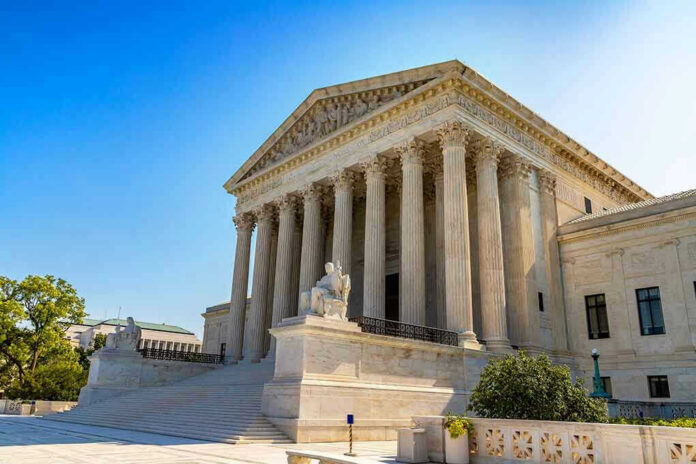
The Supreme Court just told America, in plain English, that a crying newborn on U.S. soil is a citizen—no matter what Donald Trump or anyone else thinks.
Story Snapshot
- The Supreme Court ruled 6–3 in Trump v. Barbara, striking down Trump’s limits on birthright citizenship
- Chief Justice John Roberts said kids born here to unlawfully or temporarily present parents are citizens at birth under the Fourteenth Amendment
- The Court leaned on a 1898 case, Wong Kim Ark, that has protected “citizenship by soil” for more than a century
- Justice Kavanaugh and three conservatives opened a door for Congress to tinker with the rules later
The case that put millions of babies’ status on the line
Trump v. Barbara began with one executive order and millions of families in the crosshairs. On his first day back in the White House, Trump signed Executive Order 14160 to deny automatic citizenship to children born in the United States when their mothers were here unlawfully or only on temporary status and the fathers were not citizens or lawful permanent residents.
Overnight, a baby’s passport would depend on a parent’s paperwork. Civil rights groups, led by the American Civil Liberties Union, sued on behalf of children who would be treated as foreigners in the country of their birth.
The case reached the Supreme Court as a nationwide class action and a full-on test of the Fourteenth Amendment’s Citizenship Clause. That clause says, in the blunt language of 1868, that all persons born or naturalized in the United States and subject to the jurisdiction thereof are citizens of the United States and of the state where they reside.
Trump’s lawyers claimed “subject to the jurisdiction” was a hidden escape hatch, letting the government carve out the children of undocumented immigrants and temporary visitors. The challengers said that phrase simply means you must follow U.S. law, which almost everyone on American soil does.
Roberts’ majority: the Constitution already answered this
The Supreme Court’s majority, led by Chief Justice John Roberts, treated birthright citizenship not as a new fight but as déjà vu. The opinion said children born in the United States to parents who are unlawfully or temporarily present are “born in the United States,” “subject to the jurisdiction thereof,” and therefore “citizens at birth” under the Constitution.
Roberts tied that reading directly to the Court’s 1898 decision in United States v. Wong Kim Ark, which held that a man born in San Francisco to noncitizen Chinese parents was a citizen by birthright, despite harsh anti-Chinese laws at the time.
Supreme Court strikes down Trump’s order ending birthright citizenshiphttps://t.co/omH1RXPByk
— SCOTUSblog (@SCOTUSblog) June 30, 2026
In Wong Kim Ark, the Court affirmed what it called the “ancient and fundamental rule” of citizenship by birth within the territory, with only narrow exceptions for children of foreign diplomats, enemies occupying U.S. soil, and certain tribal members. Roberts’ opinion treated Trump’s executive order as an attempt to erase that rule by fiat.
The majority flatly rejected Trump’s claim that the Fourteenth Amendment was meant only to cover formerly enslaved people and their descendants, saying the text speaks of “all persons” born here, not one class or race. That lines up with Reconstruction-era records showing lawmakers knew they were covering immigrant children as well.
The conservative split: statute versus Constitution
For conservatives who usually line up together, the Court’s right flank was notably fractured. Justice Brett Kavanaugh agreed the executive order could not stand, but he drew a sharp line on why. In his separate opinion, he argued the order violates the federal statute that codifies birthright citizenship, 8 U.S.C. § 1401(a), but does not, in his view, violate the Fourteenth Amendment itself.
That distinction matters. It says Congress, not the President, holds the power to change the rules, and suggests a future Congress might attempt to narrow birthright citizenship through legislation rather than through executive order.
Three justices—Neil Gorsuch, Samuel Alito, and Clarence Thomas—went further, siding with Trump’s theory almost completely. Their dissents focused on the phrase “subject to the jurisdiction thereof” and argued it does not cover children of foreign citizens who are in the country unlawfully or only briefly.
They leaned on older cases where the Court excluded certain Native Americans and children of diplomats from birthright citizenship, and they tried to stretch those narrow exceptions into a wider wall against modern immigration.
From a common-sense lens, their concern is clear: if citizenship is automatic, they fear it might reward illegal entry. But the problem is that their reading cuts against 127 years of precedent that has treated birthplace as the anchor of American citizenship.
What this means now—and what could come next
The ruling shuts down Trump’s executive attempt to rewrite citizenship, and it does more than that. By reaffirming Wong Kim Ark and the broad meaning of the Citizenship Clause, the Court effectively forecloses future presidents from “testing” birthright citizenship through creative orders.
The Constitution, plus existing federal law, sets a rule that does not bend for political cycles: if a baby is born on U.S. soil and the parents are subject to American law, that child is American, period, unless they fall into the tiny diplomat or enemy exceptions.
This aligns with basic respect for text, tradition, and the idea that rules should not change with each new administration.
But the open loop Kavanaugh left is real. If Congress rewrites the statute in a way that pushes the edge of the Fourteenth Amendment, another fight will land at the Court’s door. Polls already show many Republicans support adding conditions to birthright citizenship, so future lawmakers may feel pressure to “do something”.
The question then will be whether a political urge to crack down on illegal immigration can override the Constitution’s promise to every child born under the American flag. For now, at least, the Court has said that promise still stands—stronger than one president, one order, or one news cycle.
Sources:
theamericanconservative.com, en.wikipedia.org, aclu-nh.org, aclumaine.org, brennancenter.org, asianlawcaucus.org, naacpldf.org, whitehouse.gov, aila.org, travel.state.gov